
8 min - BioSense Team - 2025-01-09
- level:understanding
- CRP
- CRP ultrasensible
- inflammation
- risque cardiovasculaire
- hs-CRP
CRP blood test: normal range and what high CRP means
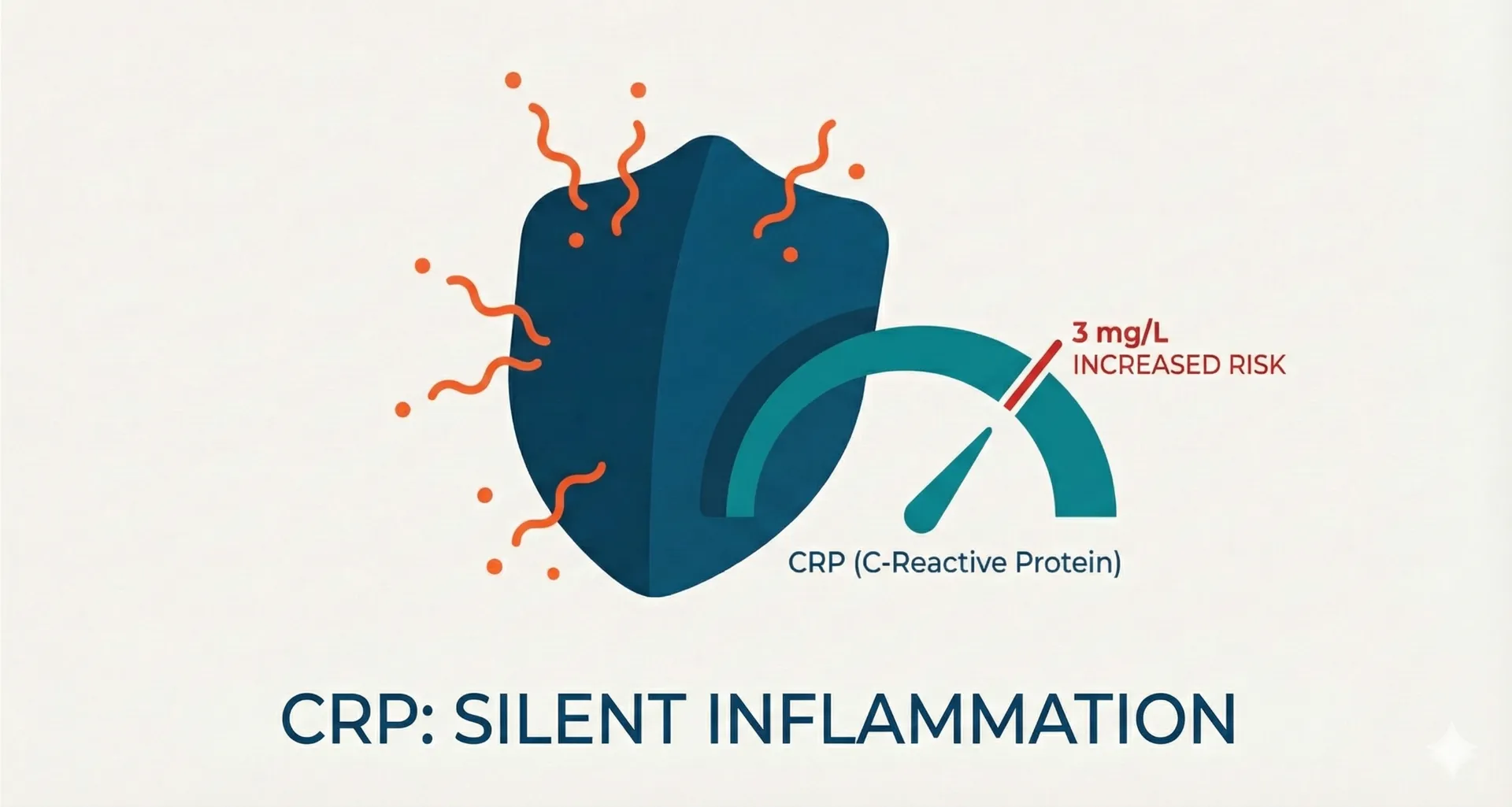
CRP (C-reactive protein) is a marker of inflammation measured with a blood test. There is no single US cutoff: MedlinePlus considers about 0.8 to 1.0 mg/dL (8 to 10 mg/L) or lower healthy, while some labs use lower limits. A clearly high value signals inflammation, such as an infection, without giving its cause. High-sensitivity CRP (hs-CRP) measures very low levels that help estimate cardiovascular risk.
Since 2025, American and European guidance has given it a clearer role in prevention. Here is how to read your result, what makes it rise and what you can discuss with your doctor.
What is CRP (C-reactive protein)?
CRP is made by the liver in response to inflammatory messengers, mainly interleukin 6. Its concentration can rise dramatically within hours during a bacterial infection, then fall within a few days once the cause has gone: its half-life is about 19 hours.
It is a non-specific marker: it signals that inflammation exists, without saying where or why. A high CRP is therefore never a diagnosis on its own; it is read together with symptoms, clinical examination and other results (white blood cells, platelets, ferritin).
Standard CRP or high-sensitivity CRP: two different uses
Both tests measure the same protein, but not in the same range of values.
| Test | What it picks up | What it is used for | |---|---|---| | Standard CRP | Higher levels | Detecting and monitoring an infection or an inflammatory disease | | High-sensitivity CRP (hs-CRP) | Very small increases | Estimating low-grade inflammation linked to cardiovascular risk |
Check the unit on your report. Many labs use mg/L, others mg/dL: 10 mg/L equals 1 mg/dL. A standard CRP may simply be given as below a limit, such as "< 5 mg/L" (0.5 mg/dL): this suggests no significant inflammation, but it does not tell you whether you are at 0.4 or at 4 mg/L (0.04 or 0.4 mg/dL). For cardiovascular prevention, high-sensitivity CRP is the test to discuss, and the order must say so.
CRP blood test: normal range and high CRP
There is no single normal range: labs set their own limits, so the range printed on your report is the reference. Rough landmarks, not diagnostic cutoffs:
- up to about 10 mg/L (1 mg/dL): often minor inflammation, common after a cold, intense exercise or a recent injury, and also seen with excess weight or smoking;
- tens of mg/L (several mg/dL): often an infection, localized inflammation or a flare of an inflammatory disease;
- above 50 to 100 mg/L (5 to 10 mg/dL): often a bacterial infection or severe inflammation, which calls for prompt medical advice, especially with fever.
CRP rises within about 6 hours and peaks at around 48 hours. A sample taken too early may therefore still be normal, and a high value can linger for several days after recovery. A repeat test a few weeks later often clarifies the situation.
High-sensitivity CRP and cardiovascular risk
Atherosclerosis, which gradually clogs the arteries, is partly an inflammatory disease. A persistently raised hs-CRP, with no infection, signals chronic low-grade inflammation associated with more heart attacks and strokes, independently of cholesterol.
The historical landmarks, set by the American Heart Association and the CDC in 2003, are as follows:
| hs-CRP | Reading | |---|---| | < 1 mg/L (0.1 mg/dL) | Lower risk | | 1 to 3 mg/L (0.1 to 0.3 mg/dL) | Average risk | | > 3 mg/L (0.3 mg/dL) | Higher risk | | > 10 mg/L (1 mg/dL) | Acute cause likely: recheck later, do not use for cardiovascular risk |
What has changed recently, and where guidance differs:
- US, ACC/AHA 2026 dyslipidemia guideline: hs-CRP is recommended selectively to refine risk assessment when traditional estimates are uncertain. For people at borderline risk, a persistent hs-CRP of 2 mg/L (0.2 mg/dL) or higher, with no identifiable cause, can weigh in favor of statin therapy.
- US, ACC 2025 scientific statement: the American College of Cardiology argues for much broader hs-CRP testing, in prevention as well as after a cardiovascular event, noting that it remains strongly predictive even in people taking a statin. This position is debated, and it is not a guideline.
- US, USPSTF 2018: an I statement. The evidence is insufficient to weigh the benefits and harms of adding hs-CRP to routine risk assessment in adults without symptoms.
- Europe, ESC/EAS 2025: the update lists persistently raised hs-CRP above 2 mg/L (0.2 mg/dL) among "risk modifiers", which can move a person at moderate risk up a risk category.
In practice, the test is not recommended for everyone: it is discussed with your doctor, alongside the lipid panel, blood pressure and smoking status. To place CRP among the other factors, see our article on integrated cardiovascular prevention and the one on LDL targets.
What raises CRP without serious disease
An hs-CRP between 2 and 5 mg/L (0.2 to 0.5 mg/dL) is very often linked to lifestyle or to a passing situation:
- excess abdominal fat: visceral fat tissue produces interleukin 6; this is a very common cause of a chronically slightly high CRP;
- smoking;
- fatty liver, often associated with slightly raised liver enzymes: see our article on ALT and AST;
- lack of physical activity;
- disturbed sleep: insomnia or poor sleep quality are associated with higher CRP (see sleep and inflammation);
- oral combined birth control pills and oral menopausal hormone therapy, which can raise CRP: tell your doctor about them;
- recent intense exercise (marathon, very long session) in the previous few days;
- a minor infection, a wound, dental care or an arthritis flare in the preceding days or weeks.
More rarely, a CRP that stays high without explanation leads the doctor to look for an inflammatory disease (joints, bowel), a persistent infection or, exceptionally, another cause. Choosing the tests is your doctor's role.
What distorts a CRP result
- A single test is not enough for cardiovascular risk: two measurements at least two weeks apart are recommended, away from any infection, using the average.
- Comparing CRP results from different methods (standard then high-sensitivity, or two labs, or two units) can create a false trend.
- Some medicines lower CRP: statins, anti-inflammatory drugs, corticosteroids, some treatments for autoimmune diseases. A low CRP under treatment does not mean the same as a spontaneously low CRP.
- The erythrocyte sedimentation rate (ESR), another inflammation marker, reacts more slowly and varies with age, anemia or pregnancy: the two are not interchangeable.
How to lower CRP naturally: what has evidence
No dietary supplement has been shown to reduce cardiovascular risk by lowering CRP. The effective levers are those that act on the cause:
- weight loss: losing excess weight generally goes with a fall in CRP;
- stopping smoking: CRP falls gradually over the following months;
- physical activity: at least 150 minutes a week of moderate activity, with muscle strengthening twice a week;
- Mediterranean-style diet: vegetables, legumes, fruit, whole grains, olive or canola oil, fatty fish;
- sleep: regular hours, and treatment of sleep apnea if it is suspected (snoring, daytime sleepiness).
The effects are judged over 2 to 3 months, not over 15 days. A drug targeting inflammation exists for some people who already have heart disease, but that decision belongs with your cardiologist.
Frequently asked questions
What CRP level is worrying on a blood test?
There is no single cutoff: a CRP above 50 to 100 mg/L (5 to 10 mg/dL), or a high CRP with fever, calls for prompt medical advice. Below that, the cause is often an infection or passing inflammation, which your doctor places in context.
My CRP is 8 mg/L (0.8 mg/dL) with no symptoms: is it serious?
Most often not. An unnoticed infection, intense exercise or an arthritis flare is enough. A repeat test a few weeks later, when you feel well, shows whether the value comes down. If it stays high, the doctor will look for a cause.
My CRP is "< 5 mg/L" (0.5 mg/dL): is my heart risk low?
This result rules out significant inflammation, but it says nothing about low-grade inflammation. Only a high-sensitivity CRP can place you below 1, between 1 and 3 or above 3 mg/L (0.1, 0.1 to 0.3 or 0.3 mg/dL).
Should everyone have a high-sensitivity CRP test?
Opinions differ. The ACC 2025 statement favors broad testing; the ACC/AHA 2026 guideline uses it selectively, the USPSTF finds the evidence insufficient, and the 2025 European guideline sees it as a way to refine a moderate risk. The decision is made with your doctor according to your other risk factors.
Can a high CRP explain my fatigue?
Persistent inflammation can cause fatigue and reduce available iron, sometimes with anemia. Your doctor may then look at the complete blood count and ferritin at the same time.
*This article is for information only and does not replace medical advice. A very high CRP with fever, pain or general deterioration calls for a prompt consultation.*
Import your blood test and get an educational reading of each of your biomarkers, placed in the context of your personal situation. Your data is hosted on servers located in France.
[→ Import my blood test](/en/onboarding/upload)
Sources and methodology
United States
- Blumenthal RS, et al. 2026 ACC/AHA multisociety guideline on the management of dyslipidemia. Journal of the American College of Cardiology, published online March 13, 2026. DOI 10.1016/j.jacc.2025.11.016. Summaries: ACC, top 10 things to know; AAFP.
- Mensah GA, et al. Inflammation and cardiovascular disease: 2025 ACC scientific statement. Journal of the American College of Cardiology 2026;87(11):1381-1404.
- Pearson TA, et al. Markers of inflammation and cardiovascular disease: a statement from the CDC and the AHA. Circulation 2003;107:499-511.
- USPSTF. Cardiovascular disease: risk assessment with nontraditional risk factors. I statement, 2018.
- MedlinePlus. C-reactive protein (CRP) test.
- Irwin MR, Olmstead R, Carroll JE. Sleep disturbance, sleep duration, and inflammation. Biological Psychiatry 2016;80(1):40-52.
- Pepys MB, Hirschfield GM. C-reactive protein: a critical update. Journal of Clinical Investigation 2003;111(12):1805-1812.
Europe
- Mach F, et al. 2025 focused update of the 2019 ESC/EAS guidelines for the management of dyslipidaemias. European Heart Journal 2025;46(42):4359-4378.
- European Society of Cardiology. What is new in the 2025 focused update of the 2019 ESC/EAS guidelines. 2025.
*BioSense methodology: our content is based on guidance from US authorities and medical societies (such as the USPSTF, CDC, NIH, FDA, ACC/AHA and ADA), UK bodies (NICE, NHS), European societies and the WHO. Sources are listed by country, and differences between countries are stated when they matter.*